
Pre-Approved for a Mortgage? Here's What NOT to Do Before Closing
Pre-Approved for a Mortgage? Here's What NOT to Do Before Closing
Getting pre-approved feels pretty damn good.
You did the paperwork. We ran the numbers. You know your price range. Maybe you even found the house.
Now comes the part nobody talks about enough:
Don't accidentally mess with the math between pre-approval and closing.
Mortgage markets can move. Rates can move. The 10-year Treasury can have a meltdown before you've finished your coffee.
You can't control that.
I can't either.
But you have a lot of control over what happens inside your own mortgage file.
And once you're pre-approved, boring is beautiful.
Is a mortgage pre-approval final?
Nope.
Think of your pre-approval as a snapshot of your finances at a specific point in time, not a finish line.
We looked at things like your income, employment, credit, assets and monthly debts and said:
Based on what we know today, here's what the numbers look like.
Then life keeps happening.
Before you close, information in your file may need to be updated or verified again.
So if your financial picture changes significantly between pre-approval and closing, your mortgage numbers can change with it.
That's why I tell my buyers:
Once you're under contract, don't freelance.
Call me first.
Can I buy a car after getting pre-approved for a mortgage?
Please don't surprise me with a new F-150 three days before closing. 😂
A new auto loan means a new monthly payment.
Your mortgage qualification is based partly on your debt-to-income ratio (DTI)—basically how much monthly debt you have compared with your qualifying monthly income.
Add another $700, $800 or $1,000 monthly payment and we may have to qualify the loan all over again with that payment included.
Could you still qualify?
Maybe.
But let's figure that out before you're sitting in the dealership signing paperwork.
Can I open a new credit card before closing?
This includes:
A regular credit card
Store financing
Furniture financing
Appliance financing
A “save 15% if you open a card today” offer
Pretty much anything else involving new credit
Opening new credit can potentially affect your credit profile and/or create a new monthly obligation.
And yes, I understand the temptation.
You just bought a house.
You need a couch.
Maybe a TV.
Maybe the giant sectional that somehow costs as much as my first car.
Wait.
The couch will still be there after closing.
Does a mortgage lender check your credit again before closing?
It can happen, and lenders have processes for identifying new debts or changes before closing.
That's why the goal isn't to “get through” the first credit check and then go shopping.
The goal is to keep the financial picture we used to qualify you as stable as possible until the transaction is complete.
If something needs to change, tell me first.
Can I change jobs before closing on a house?
Potentially—but this is absolutely a call-me-before-you-do-it situation.
A job change isn't automatically bad.
You might even be getting a raise.
Nice. I'm all for it.
But changing employers, moving from salary to commission, changing your hours, becoming self-employed or changing how you're paid can affect how your qualifying income has to be documented or calculated.
So before you give two weeks' notice:
Call me.
Let's figure out what the change does to the mortgage before you make it.
Can I move money between bank accounts before closing?
Usually moving your own money isn't inherently a problem.
The issue is documentation.
If money starts bouncing between checking, savings, investment accounts and somewhere else, we may need to follow the trail.
Same thing with a large deposit.
Getting gift money from family?
Selling a car?
Moving money from investments?
Big bonus hitting your account?
None of those things automatically means something is wrong.
I just don't want to discover it when we're trying to get you cleared to close.
Call before you move the money.
We'll make sure we know what documentation may be needed.

What should you NOT do before closing on a house?
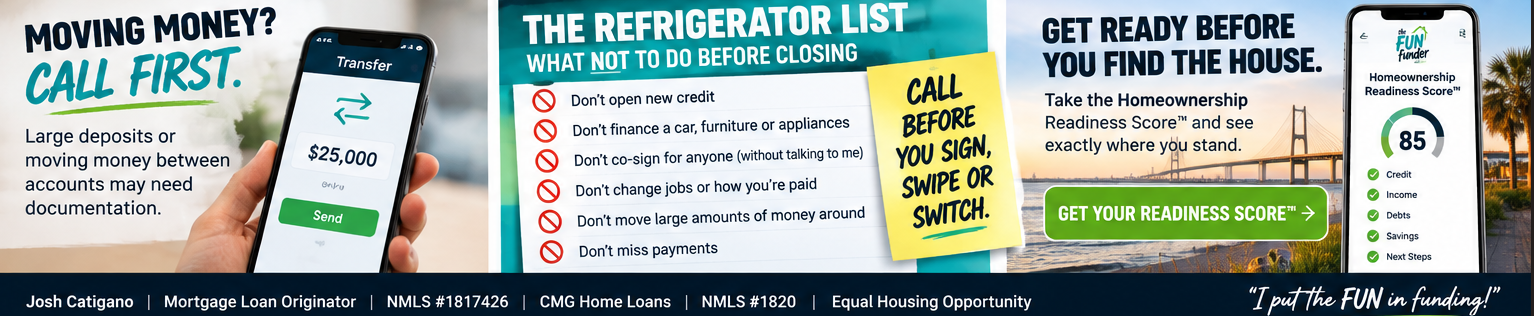
Here's the refrigerator version:
Don't open new credit without talking to your loan officer.
Don't finance a car, furniture or appliances without talking to your loan officer.
Don't co-sign a loan without talking to your loan officer.
Don't change jobs or how you're paid without talking to your loan officer.
Don't start moving large amounts of money around without talking to your loan officer.
Don't miss payments.
And don't make major changes to existing credit accounts just because somebody on TikTok told you it'll boost your score.
There may be perfectly legitimate reasons to do any of these things.
I just want to know before, not after.
The one rule that covers almost everything
If you forget this entire article, remember six words:
Call before you sign, swipe or switch.
Buying a car?
Call.
Opening credit?
Call.
Changing jobs?
Call.
Moving $20,000?
Definitely call.
Five minutes on the phone is a whole lot more fun than trying to fix something three days before closing.
And, you know...
I put the FUN in funding.
Not the “why is underwriting asking about this new $900 car payment?” in funding. 😂
One for my real estate agent partners
This is worth sharing with your buyer the day they go under contract.
That's when they're excited.
They're measuring rooms.
They're picking furniture.
They're mentally mounting the 75-inch TV over a fireplace they don't technically own yet.
That's also exactly when we want them to hear:
Don't finance anything until you talk to Josh.
One quick reminder can protect the buyer, the financing and your closing timeline.
Get mortgage-ready before you find the house
The buyers who tend to have smoother closings aren't necessarily lucky.
They're prepared.
They understand their credit.
They know their debts.
Their money is organized.
And they know what not to change once the mortgage process starts.
That's exactly why I built the Homeownership Readiness Score™.
It takes about 60 seconds.
No credit pull. No cost. No guessing.
You'll get a clearer picture of where you stand today and what you may want to work on before you're under contract.
Get Your Homeownership Readiness Score™ →
https://thefunfunder.com/readiness-score-page
Preparation beats prediction. Every time.
Josh Catigano
the FUN funder
CMG Home Loans | NMLS #1817426
Equal Housing Opportunity
“I put the FUN in funding!”
This article is for general educational purposes. Credit, income, employment, asset and debt documentation requirements vary by loan program, lender guidelines, underwriting findings and individual borrower circumstances. Changes to your credit, employment, income, debts or assets may affect mortgage qualification. All loans are subject to underwriting approval. This is not a commitment to lend.