Your Bank Statements Talk: How to Get Your Down Payment Money Mortgage-Ready

Your Bank Statements Talk: How to Get Your Down Payment Money Mortgage-Ready
Here’s a question almost nobody asks before they apply for a home loan:
What will my bank statements say about me?
Probably more than you think.
And if buying a home is somewhere on your radar, getting your money organized before you apply can save you a whole lot of unnecessary aggravation later.
The market's been tough. Your file doesn't have to be.
We've spent a lot of time this week talking about mortgage rates and the bond market.
And for good reason. It's been a rough stretch.
But here's the thing:
You can't control the bond market.
Neither can I.
What you can control is whether your mortgage file is ready when the right house shows up.
And one of the biggest pieces of that file is sitting right inside your bank account.
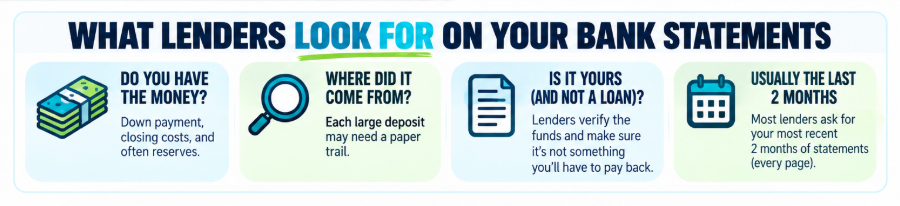
What do mortgage lenders look for on bank statements?
First, they're not judging your coffee habit.
Promise.
Your bank statements are primarily helping answer a few important questions:
Do you have enough verified money for the transaction?
That can include your down payment, closing costs and, depending on the loan, reserves.
Reserves are simply money you still have available after closing — basically some financial cushion.
The other big question is:
Where did the money come from?
That's where things can get interesting.
For many conventional purchase loans, bank statements may cover the most recent two months of account activity, although documentation requirements vary by loan program, underwriting findings and how the assets are verified.
What is considered a large deposit for a mortgage?
This is one of those mortgage phrases that gets thrown around without much explanation.
A large deposit isn't simply any deposit your lender doesn't recognize.
The exact treatment depends on your loan program and situation.
For example, under current Fannie Mae conventional guidelines, a large deposit is generally a single deposit exceeding 50% of the total monthly qualifying income being used for the loan. If those funds are needed for a purchase, the lender may need to document that they came from an acceptable source.
Plain English?
If a chunk of money suddenly appears in the account you're using to buy a house, don't assume nobody is going to ask about it.
That's not necessarily a problem.
We just may need to show where it came from.
Why does the source of your down payment matter?
Because having money and having verified funds for a mortgage aren't always the same thing.
If we're using money toward your down payment, closing costs or reserves, we may need to document that it's from an acceptable source and isn't an undisclosed loan you'll have to repay.
Some money is incredibly easy to follow.
Your normal payroll deposit? Usually pretty obvious.
Other deposits can require a little more documentation.
Here are a few common examples.
You sold something
Maybe you sold a car, boat, golf cart or another valuable asset.
Great.
Keep the paperwork.
Depending on the situation, documentation could include things like proof you owned it, a bill of sale and evidence that you actually received the money. Fannie Mae, for example, specifically permits proceeds from the sale of personal assets when the required documentation is provided.
Family is helping with your down payment
Gift funds can absolutely be an option with many mortgage programs.
But don't have Mom randomly Venmo you $20,000 and figure we'll sort it out later.
Talk to me first.
The documentation and transfer process can vary depending on the loan program. It's much easier to structure it correctly from the beginning than reconstruct it afterward.
You're moving money between your own accounts
Totally normal.
Maybe you're moving money from savings to checking. Maybe you're liquidating an investment account.
That doesn't automatically create a problem.
But we may need to follow the money from one verified account to another.
In some conventional scenarios, if the transfer between verified accounts is clearly identified on the statement, additional documentation may not even be necessary.
That's why I keep coming back to the same advice:
Ask before you move it.
You have cash
Cash is where things can get messy.
If you've been saving physical cash, getting paid cash from a side gig or have money sitting somewhere outside the banking system, talk to your loan officer before depositing it into the account you're planning to use for the mortgage.
Don't wait until you're under contract and then drop a pile of cash into the bank.
There may be ways to structure your finances appropriately depending on the situation and loan program.
But it's much easier when we know about it beforehand.

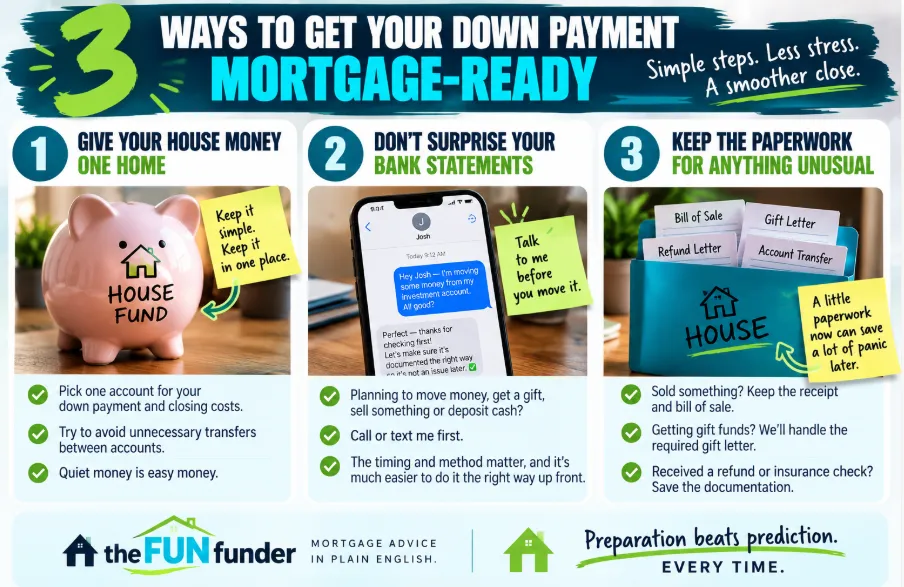
Three ways to get your down payment mortgage-ready
1. Give your house money one home
If possible, pick an account where you're going to keep the money intended for your home purchase.
Then try to keep things simple.
I'm not saying you're forbidden from moving your own money.
I'm saying that every unnecessary transfer can potentially create another transaction we need to understand.
Quiet money is easy money.
2. Don't surprise your bank statements
Planning to move money from investments?
Receiving help from family?
Selling something?
Getting a large refund or insurance check?
Awesome.
Call or text me before you move it.
Sometimes the difference between an easy file and an annoying one is simply doing the exact same thing in the right order.
3. Keep the paperwork
This one's easy.
If something unusual happens with money you're planning to use for the house, save whatever explains it.
Sold something? Keep the bill of sale.
Received a refund? Keep the documentation.
Getting gift funds? We'll handle the required paperwork together.
You don't need a giant filing cabinet.
Make a folder on your phone called HOUSE.
Done.
A little paperwork now can save a whole lot of panic later.
Can an undocumented deposit stop you from buying a house?
Not automatically.
This is another place where internet mortgage advice tends to get dramatic.
An undocumented deposit doesn't necessarily mean your entire loan is dead.
For example, under Fannie Mae's conventional guidance, when an undocumented large deposit is involved and those funds would otherwise be needed for the purchase, the lender may be able to exclude the undocumented amount and determine whether the remaining verified assets are still sufficient for the transaction.
Translation:
You might have $30,000 sitting in the bank, but that doesn't necessarily mean all $30,000 can be used for mortgage qualification if part of it can't be properly verified.
That's why I want to find these things before you're under contract.
Not three days before closing.
The buyers who are ready have an advantage
Here's what tough mortgage markets remind us of.
The buyers who close smoothly usually aren't the people who perfectly predicted where rates were going.
They're the people who knew their numbers and had their financial house in order before they found the house they wanted to buy.
They knew their payment.
They understood their credit.
They had their documents.
And their down payment money was ready to go.
Preparation beats prediction. Every time.
You can't control the 10-year Treasury.
But you can absolutely control what your bank statements say when it's go time.
How mortgage-ready are you?
Not sure whether your finances are actually ready for a mortgage?
Start with my Homeownership Readiness Score™.
It takes about 60 seconds.
No credit pull. No cost. No guessing.
You'll get a clearer picture of where you stand today and what your next move should be.
Get Your Homeownership Readiness Score™ →
https://thefunfunder.com/readiness-score-page
And if you have a weird deposit sitting on your statement and you're wondering, “Josh, is this going to be a problem?”
Shoot me a text.
I'd much rather look at it now than explain it three days before closing.
Josh Catigano
the FUN funder
CMG Home Loans | NMLS #1817426
Equal Housing Opportunity
“I put the FUN in funding!”
This article is for general educational purposes. Asset verification, bank statement, gift fund, large-deposit, reserve and source-of-funds requirements vary by loan program, underwriting findings and individual borrower circumstances. All loans are subject to underwriting approval. This is not a commitment to lend.