
Why Does the Jobs Report Affect Mortgage Rates? What Homebuyers Should Watch Tomorrow
Why Does the Jobs Report Affect Mortgage Rates? What Homebuyers Should Watch Tomorrow
If you're watching mortgage rates right now, tomorrow could be interesting.
Not because anyone knows rates are going up.
Not because anyone knows they're going down.
But because tomorrow morning we get one of those economic reports that can actually make the bond market move: the monthly jobs report.
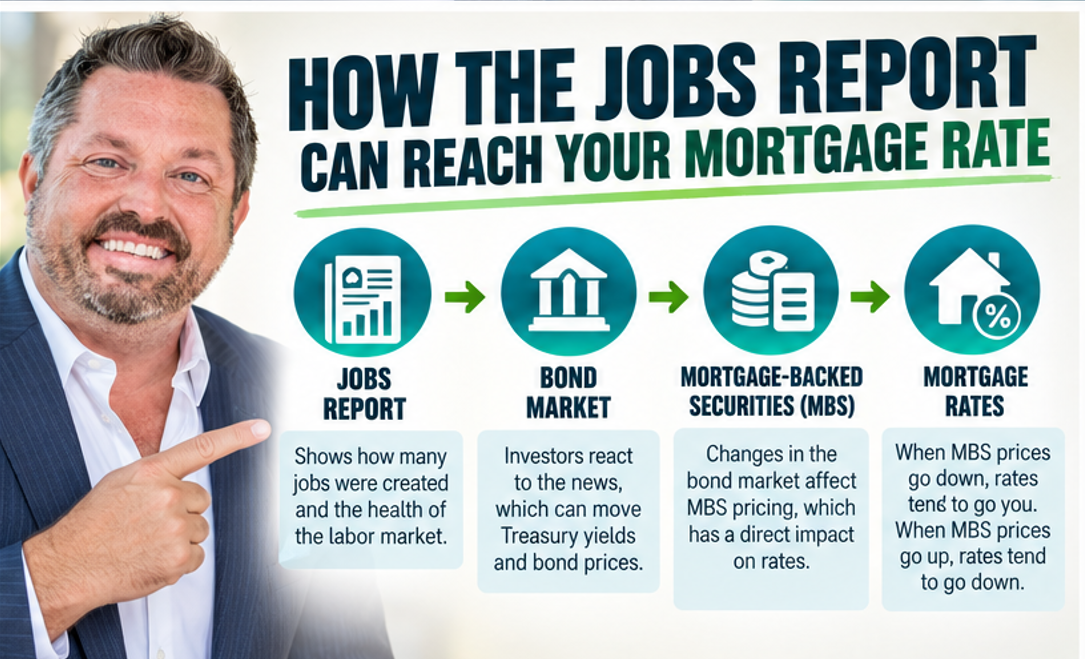
And since mortgage rates are heavily influenced by what's happening in the bond market, homebuyers may feel that move pretty quickly.
So rather than trying to guess what happens tomorrow, let's talk about why the jobs report affects mortgage rates in the first place—and what that actually means if you're trying to buy a house.
Why are mortgage rates so sensitive right now?
The bond market has been pretty volatile lately.
This morning, the 10-year Treasury yield was around 5.30%, reaching levels we haven't seen since 2002, according to MBS Highway's October 1 market update.
Mortgage bonds, meanwhile, were trading relatively flat this morning—but in a pretty wide range.
That's important because mortgage rates don't simply follow the 10-year Treasury tick-for-tick. As I talked about in yesterday's article, mortgage rates are more directly connected to mortgage-backed securities (MBS).
But Treasury yields, mortgage bonds, inflation expectations and investor sentiment all interact.
Right now, the market is paying particularly close attention to two things:
Inflation and jobs.
How does the jobs report affect mortgage rates?
Here's the simple version.
A stronger-than-expected jobs report can put upward pressure on bond yields and mortgage rates because it suggests the economy and labor market are still strong.
A weaker-than-expected jobs report can sometimes help bonds and put downward pressure on mortgage rates because it can suggest the economy is slowing.
Notice the words “can” and “sometimes.”
That's intentional.
There is no formula that says:
Good jobs report = mortgage rates go up exactly X%.
Markets are looking at the whole report, what investors expected beforehand, revisions to previous reports, inflation, Federal Reserve expectations and a whole bunch of other things.
That's why I don't want homebuyers trying to trade the bond market from their kitchen table.
What is expected in tomorrow's jobs report?
According to the market expectations cited in this morning's MBS Highway update, economists are looking for approximately 90,000 jobs created in September, with the unemployment rate expected to remain around 4.1%.
But the other employment data leading into tomorrow has been mixed.
ADP reported about 90,000 private-sector jobs created, stronger than expectations of roughly 70,000.
Another employment estimate cited by MBS Highway, from Revelio Labs, showed about 57,000 jobs created, with private payroll growth considerably lower than ADP's estimate.
Challenger's September report also showed hiring plans falling to their lowest September level in 15 years, according to MBS Highway.
So everybody gets to tomorrow morning with the same question:
Which version of the labor market shows up in the official jobs report?
Why revisions matter too
Here's something that doesn't get nearly as much attention as the headline number.
Jobs reports get revised.
Last month's report showed 162,000 jobs created, which was significantly stronger than expected and helped kick off some of the pressure we've seen in bonds and mortgage rates since then.
But tomorrow isn't only about September's number.
Markets will also be watching to see whether previous employment numbers get revised.
That's important because financial markets aren't just asking:
“How many jobs were created last month?”
They're trying to answer:
“Is the labor market getting stronger, weaker, or basically staying the same?”
Sometimes the revisions help answer that question better than the headline does.
What does inflation have to do with mortgage rates?
A lot.
The latest Core PCE inflation reading came in at 3.0% year over year, according to today's MBS Highway update. That was better than the 3.3% market expectation cited in the report, but still above the Federal Reserve's inflation target.
Why should a homebuyer care?
Because inflation is bad for bonds.
If investors believe inflation will remain elevated, they generally demand higher yields to compensate for the declining purchasing power of future payments.
Higher bond yields can contribute to higher mortgage rates.
That's why you'll constantly hear mortgage people talking about seemingly unrelated things like:
jobs, inflation, the Fed, Treasuries and mortgage-backed securities.
They're all pieces of the same puzzle.
Does a weak jobs report mean mortgage rates will fall?
No.
And I really want to emphasize this one.
A weaker-than-expected jobs report could be favorable for mortgage bonds, particularly if it changes investors' expectations about economic growth or Federal Reserve policy.
But that doesn't guarantee mortgage rates will fall tomorrow.
The market could already have priced in some of the expectation.
Another part of the report could surprise investors.
Previous months could be revised.
Bond-market volatility could remain elevated.
Or the market could simply react differently than everyone expects.
If you've read my stuff for more than five minutes, you probably know where I'm going with this.
Preparation beats prediction.
Should you wait for the jobs report before locking a mortgage rate?
That depends on your individual situation.
There isn't a universal answer to “Should I lock my mortgage rate today or wait?”
Your closing date matters.
Your loan program matters.
Your risk tolerance matters.
Your current rate and pricing matter.
And most importantly, the difference between a slightly better rate tomorrow and a worse one tomorrow matters differently depending on your actual loan amount and monthly payment.
That's why I don't like making mortgage decisions based on:
“I heard rates might drop Friday.”
Maybe they will.
Maybe they won't.
Let's look at your numbers instead.
What should homebuyers actually watch?

If you're thinking about buying a home, you don't need CNBC running on six TVs in your living room.
You need to understand a few basic things:
Your comfortable monthly payment.
What payment actually works for your life?
Your debt-to-income ratio.
How much room do we have if mortgage rates move?
Your credit.
Could improving your credit potentially improve your financing options?
Your cash to close.
How much do you have available for down payment, closing costs and reserves?
Your timeline.
Are you buying next week, three months from now or next year?
Those things are considerably more useful to me than whether you correctly guessed tomorrow's jobs number.
So, will tomorrow's jobs report change mortgage rates?
It could.
Tomorrow's employment report is an important piece of economic data, and a meaningful surprise in either direction could create movement in bonds and mortgage rates.
But here's the part I want homebuyers to remember:
You don't have to predict tomorrow's mortgage rate to make a good homebuying decision.
You need to understand what today's numbers mean for you.
That's the difference between watching the market and actually having a mortgage plan.
Find out where you stand
If you're thinking about buying a home but you're not sure whether you're actually ready, start with my Homeownership Readiness Score™.
It takes about 60 seconds. No credit pull. No paperwork. No pressure.
It'll give you a clearer idea of where you stand and what your next step should be.
👉 Take the Homeownership Readiness Score™:
https://thefunfunder.com/readiness-score-page
Stop guessing. Start planning.
Josh Catigano | the FUN funder | CMG Home Loans | NMLS #1817426 | Equal Housing Opportunity
"I put the FUN in funding!"
Market information referenced from MBS Highway's October 1, 2026 Morning Update. Market conditions can change without notice. Treasury yields are not consumer mortgage rates, and movements in economic data, Treasury securities or mortgage-backed securities do not guarantee a corresponding change in mortgage rates. Rates and loan terms vary based on borrower qualifications, loan program, property and market conditions. This information is for educational purposes only and is not a commitment to lend. All loans are subject to approval.