
What Is a Temporary Mortgage Buydown? Lower Payments Now—But What's the Catch?
What Is a Temporary Mortgage Buydown? Lower Payments Now—But What's the Catch?
You've probably seen it advertised.
"Buy a house and get a lower mortgage payment for the first year!"
Sounds pretty good, right?
And depending on your situation, it actually can be.
But here's where I see buyers getting confused. They hear lower payment and automatically think they're getting a lower mortgage rate.
Not exactly.
There's a difference between temporarily reducing your mortgage payment and permanently lowering your interest rate.
And before you get excited about either one, you need to understand what you're actually getting.
Let's break it down. No mortgage mumbo jumbo required.
What is a temporary mortgage buydown?
A temporary mortgage buydown is a financing arrangement that reduces your mortgage payment for a specific period at the beginning of your loan.
Think of it as a little breathing room while you're settling into your new home.
Here's how it works.
Your mortgage has an actual interest rate, called the note rate. That's the rate written into your loan agreement.
With a temporary buydown, money is set aside upfront to subsidize part of your monthly payment for a certain period.
The result?
You make a lower payment initially, even though your actual note rate hasn't changed.
Once the temporary buydown period ends, that payment subsidy goes away, and you begin making the regular payment based on your note rate.
The important distinction:
Temporary buydown = temporary payment relief.
Permanent rate buydown = an actual reduction in your mortgage interest rate.
Two different tools. Two different strategies.
How does a 2-1 mortgage buydown work?
This is one of the most common questions I get.
A 2-1 buydown generally works like this:
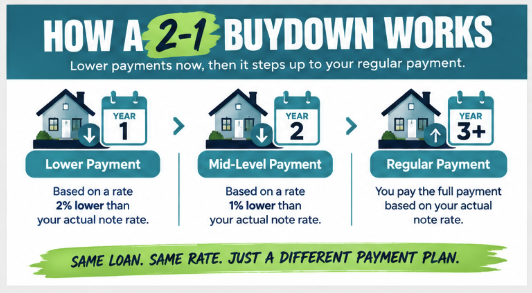
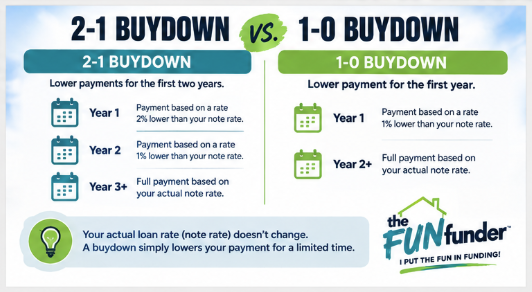
Year 1: Your principal-and-interest payment is calculated using a rate 2 percentage points below your actual note rate.
Year 2: Your principal-and-interest payment is calculated using a rate 1 percentage point below your note rate.
Year 3 and beyond: You make the full principal-and-interest payment based on your note rate.
For example, if your note rate were 7%, a traditional 2-1 buydown would calculate the first year's principal-and-interest payment using 5%, the second year's using 6%, and the remaining years using 7%.
Those numbers are simply an illustration of the structure, not a current rate quote or loan offer.
Your actual note rate remains the same throughout.
And remember, property taxes, homeowners insurance, mortgage insurance and other applicable housing costs aren't necessarily reduced by a temporary buydown.
The buydown changes the payment subsidy. It doesn't change the price of the house or erase the other costs of owning it.
What about a 1-0 buydown?
Same general idea, shorter timeline.
With a traditional 1-0 temporary buydown, your principal-and-interest payment is calculated using a rate 1 percentage point below your note rate for the first year.
Starting in year two, you make the full payment based on your note rate.
Different buydown structures may be available depending on the lender, loan program and transaction.
The important thing isn't memorizing every variation.
It's understanding how much the payment changes, when it changes, and who is paying for the subsidy.
Who actually pays for a temporary mortgage buydown?
Ahhh. Now we're asking the right questions.
Because here's something I tell buyers all the time:
Follow the money.
A temporary buydown requires money upfront to cover the difference between the reduced payments and the regular payments during the buydown period.
Depending on the loan program and transaction, that money may come from:
The seller: Sometimes negotiated as part of the purchase agreement.
The builder: Sometimes offered as an incentive on eligible new-construction purchases.
The lender: Certain lender programs may provide a temporary buydown through an eligible lender-funded arrangement.
The rules aren't identical across every loan program, and not every type of contribution is allowed in every situation.
Here's what I want you to ask:
Who's funding the buydown, and what am I giving up—if anything—to get it?
Could you use the seller's contribution toward closing costs instead?
Would a permanent rate buydown make more sense?
Is the builder offering the incentive instead of negotiating on the purchase price?
These are the conversations worth having.
Because the best-looking incentive isn't automatically the best financial decision.
What's the catch with a temporary buydown?
The biggest catch isn't necessarily a hidden fee.
It's what happens when the temporary payment ends.
Let's say you move into your new house and enjoy a lower payment for the first year.
Great!
But eventually that subsidy runs out.
And the regular mortgage payment kicks in.
That's not a surprise if you planned for it.
It's a pretty unpleasant surprise if you didn't.
Here's the question I'd rather have you ask:
"Can I comfortably afford this house at the FULL payment?"
Not just the introductory payment.
Not the payment you hope to have after refinancing.
The actual payment you're planning around when the buydown expires.
A temporary buydown can help with cash flow in the early years. But it shouldn't be the only reason you feel comfortable buying the house.
And while refinancing might become an option later, nobody can promise what mortgage rates or your financial circumstances will look like.
Hope is not a mortgage strategy.
A plan is.
Is a 2-1 buydown better than a permanent rate buydown?
Now this is where things get interesting.
Because the answer isn't always the same.
A temporary buydown may be appealing if you value lower payments during your first year or two in the home.
A permanent rate buydown may be worth considering if you expect to keep the mortgage for a long time and want a lower note rate throughout the loan.
But the comparison depends on the actual cost, available credits, loan terms, and how long you expect to keep the mortgage.
For example, if a seller is willing to contribute toward your purchase, we might want to compare different permitted uses of that money.
Maybe it makes sense to reduce your upfront closing costs.
Maybe a temporary buydown fits your cash-flow goals.
Maybe a permanent rate reduction offers better long-term value.
Same house. Same buyer. Different ways to structure the financing.
That's why I don't love one-size-fits-all mortgage advice.
The right answer comes from looking at the numbers together.
Can a temporary buydown help you qualify for a mortgage?
This is another area where people get tripped up.
A lower introductory payment doesn't automatically mean you qualify for a larger loan.
Mortgage qualification rules depend on the loan program, applicable underwriting requirements and the specific buydown arrangement.
For many common temporary buydown structures, qualification is based on the full note-rate payment rather than the temporarily reduced payment.
So don't assume a temporary buydown solves a debt-to-income ratio problem.
If you're wondering how your monthly debts affect what you may qualify for, that's a separate piece of the mortgage puzzle—and one worth understanding before you start shopping.
When does a temporary buydown actually make sense?
I like temporary buydowns as an option to evaluate, not as something every buyer automatically needs.
They can be worth exploring when:
You want additional breathing room during your first year or two of homeownership.
A seller or builder is offering eligible financing incentives.
You can comfortably handle the regular payment once the buydown ends.
The total cost and benefits compare favorably with your other financing options.
But I also want to see the bigger picture.
How much cash will you have left after closing?
Are you stretching your monthly budget?
Do you have other debts you're trying to pay down?
How long do you realistically expect to stay in the home?
Those questions matter just as much as the introductory mortgage payment.
And if you've already started preparing to buy, keeping your mortgage documentation current is another smart move.
I explain that here: Keep Your Mortgage File Fresh.
Don't let the incentive become the strategy
Look, I get it.
Buying a home is expensive. And when somebody offers a way to lower your payment for a while, of course you're going to be interested.
You should be!
But I don't want you chasing a shiny mortgage incentive without understanding the whole deal.
A temporary buydown can be a useful tool.
It's just not a substitute for a good mortgage plan.
And that's really what this comes down to.
Stop guessing. Start planning.
Before we worry about the perfect interest rate, the perfect buydown or the perfect day to buy, let's figure out what actually works for you.
So, how ready are you to buy?
If buying a home is on your radar, you don't need to have every answer figured out today.
You just need to know where you're starting.
That's why I created the Home Readiness Score™.
In about 60 seconds, you can get a clearer picture of where you stand and what your next steps might look like.
No credit pull. No pressure. No guessing.
Take Your Home Readiness Score™
And if you want to talk through whether a temporary buydown makes sense for your situation, let's look at the actual numbers.
Because I'm not here to sell you a mortgage gimmick.
I'm here to help you make a smart mortgage decision.
See? Mortgages don't have to be complicated.
Josh Catigano
the FUN funder
CMG Home Loans | NMLS #1817426
Equal Housing Opportunity
I put the FUN in funding!
Educational information only. Temporary buydown availability, funding, eligibility, qualifying requirements and permitted contributions vary by loan program and lender. Illustrative rates are not current offers or advertised pricing. Mortgage payments may also include taxes, insurance and other charges. All loans are subject to underwriting approval. This is not a commitment to lend.